

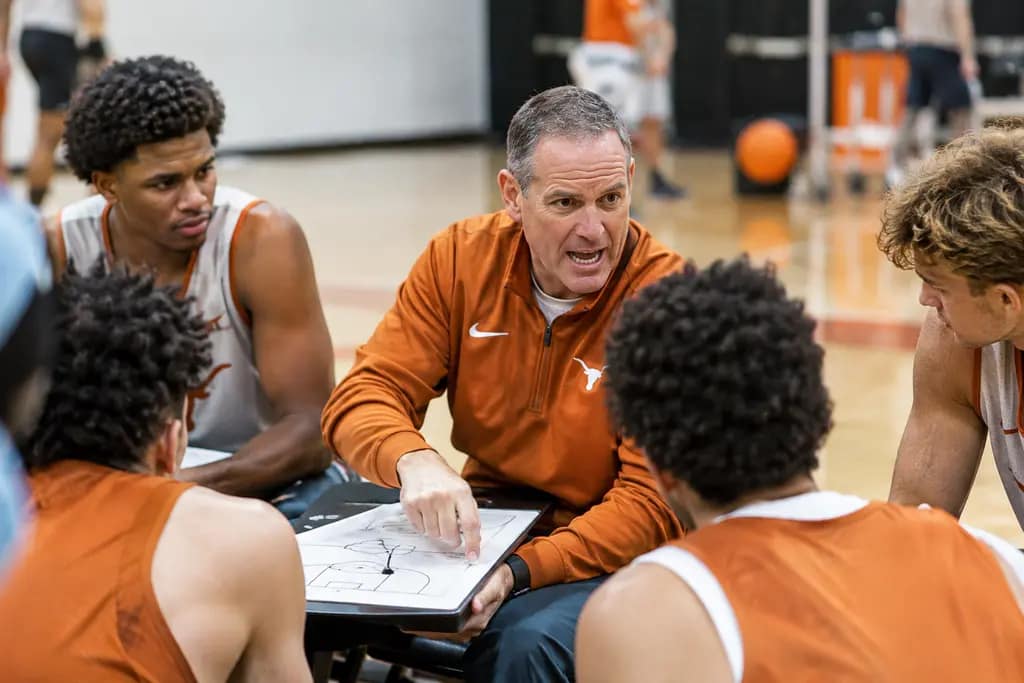
Texas Coaching Changes have already altered how local fans should read program strength across Austin, College Station, Houston and Lubbock. Since March 2025, Texas and Texas A&M made major head-coaching moves, Houston kept its established leader in place, and Texas Tech adjusted staff roles for the 2026-27 cycle. The impact is less about press-conference energy and more about roster trust, recruiting contact, player retention and late-game identity.
For Texas fans, this coaching cycle has been about two related questions: who can build fast enough for SEC pressure, and who can keep a roster stable long enough for player development to show up in March? Those questions matter for alumni, students, high school coaches and families watching the state’s recruiting race.
Why Texas Coaching Changes Matter For Texas Fans
Texas Coaching Changes And Recruiting Trust
Recruiting starts with belief. Prospects want a clear style of play, honest role projections and a staff that appears likely to stay. For families watching Texas Coaching Changes from the high school and grassroots levels, contract length and staff continuity can matter almost as much as a coach’s name recognition.
Texas made the loudest move in the state when it hired Sean Miller on March 24, 2025. He became the 27th men’s basketball head coach in Longhorns history after arriving with a 487-196 career record over 20 seasons, plus eight Sweet Sixteen appearances and four Elite Eight trips. The UT System Board of Regents then approved a six-year, $32 million guaranteed contract for Miller in March 2025, according to the AP report on Miller’s contract.
That size of commitment told recruits and current players that Texas was not treating the move as a short trial. It also placed Miller under a clear standard: build a rotation that can handle SEC physicality, retain enough skill to space the floor and give Austin fans a team identity they can recognize from month to month.
The change came after Rodney Terry had been named the full-time Texas head coach on March 27, 2023. Terry’s Texas run, including his interim work, included a 72-34 overall record across his first three seasons and a 5-3 NCAA Tournament mark. He also guided the Longhorns to their first Elite Eight in his first season as head coach. That record is part of why the shift to Miller was not a simple reset. It was a choice to chase a different long-range roster model after Texas moved into the SEC.
For readers tracking Austin roster construction, our related look at Texas Longhorns Basketball rotation keys connects Miller’s second-year roster questions with lineup balance, size and transfer depth.
How Texas And Texas A&M Built Different Kinds Of Stability
Sean Miller’s Austin Task
Miller entered his second year at Texas for the 2026-27 season with a clear job: turn institutional backing into daily standards. His previous record shows he knows how to win across a long coaching career, but the Texas job brings a specific local demand. The Longhorns need to win recruiting conversations inside the state while proving that players from Texas, transfers and returning veterans can fit into one system.
That is where coaching strategy becomes more than play-calling. A new coach has to define practice pace, defensive accountability, shot selection and substitution patterns before close games expose weak habits. Texas has the resources to attract talent, but resources alone do not create late-clock execution or defensive rebounding.
Bucky McMillan’s College Station Momentum
Texas A&M chose a different path with Bucky McMillan, who was hired on April 4, 2025, replacing Buzz Williams. McMillan’s first season changed the tone quickly. On March 28, 2026, Texas A&M awarded him a contract extension running through the 2031-32 season after the Aggies went 22-11 and finished fourth in the SEC despite being picked 13th before the season, according to the Texas A&M contract announcement.
Texas Coaching Changes at A&M feel different because McMillan’s first-year production already gave the administration a reason to act. His 22 wins were the second-most by a first-year coach at Texas A&M, behind Mark Turgeon’s 25 victories in 2007-08. That matters in recruiting because early proof reduces the sales pitch. Instead of asking prospects to imagine a future identity, the Aggies can point to a first-year jump in SEC standing.
The Aggies still had work to do after the extension. A fast first season can raise expectations before a program has built deep continuity. The coaching task in College Station became turning surprise into a standard: keeping defensive effort high, keeping player roles clear and making sure the transfer cycle does not erase the culture that produced the first-year rise.
Houston And Texas Tech Show The Value Of Continuity

Kelvin Sampson Removed Doubt In Houston
Not every major coaching story involves a new hire. Kelvin Sampson confirmed on March 28, 2026, that he would return as Houston’s head coach for the 2026-27 season, ending retirement speculation after the Cougars had fallen in the Sweet Sixteen. At that point, Houston had reached the regional semifinals for the seventh straight time, the longest active streak nationally noted in the research.
Texas Coaching Changes can also be measured by the changes that did not happen. Houston’s 2025-26 season included a program-record fourth straight 30-win season, Big 12 regular season and tournament titles, and national coach of the year recognition from CBS Sports and The Sporting News for Sampson, along with Big 12 Coach of the Year honors.
For Houston-area fans, Sampson’s return gave the Cougars something many programs chase but rarely hold: an identity that does not need to be reintroduced every November. Players know the defensive demands. Opponents know the rebounding standard. Recruits know the program’s personality before their first campus visit.
Texas Tech’s Staff Updates Were Smaller But Meaningful
Texas Tech did not make the same headline-level head-coaching shift in the research notes, but Grant McCasland’s staff updates reported on September 18, 2026, still fit the success discussion. Staff organization affects film work, player schedules, recruiting support, campus relationships and the communication that helps a roster function over a long season.
- Jardon Powell was promoted to Assistant Athletics Director, Men’s Basketball Administration & External Engagement.
- Brian Pete was elevated to Special Assistant to the Head Coach.
- Duncan Bacon was named Director of Basketball Operations.
Those moves suggest Texas Tech valued continuity inside McCasland’s program structure. Fans often focus on the head coach, but operations roles can shape how smoothly a team handles travel, practice planning, recruiting visits and player support. In a state where programs compete for the same prospects and transfers, small staff details can affect whether a player feels organized support every day.
What Texas Coaching Changes Mean For Local Hoops
The most useful way to read this coaching cycle is through community impact. Texas Coaching Changes affect more than university press releases. They reach high school gyms, summer events, family recruiting conversations and local fan expectations from Austin to College Station to Houston to Lubbock.
Texas placed a major financial commitment behind Miller, asking him to convert proven career success into SEC results. Texas A&M rewarded McMillan quickly after a 22-win first season that beat preseason projections. Houston gained clarity when Sampson stayed after another deep NCAA Tournament run. Texas Tech invested in staff roles that support continuity under McCasland.
For local fans, the next measure is not hype. It is whether these staffs help players improve, keep locker rooms steady and build styles that survive conference play. The programs that get those details right will not just win recruiting announcements. They will give Texas basketball communities teams that feel connected, prepared and worth following closely through the grind of college hoops.