


The Lone Star Showdown finished as a Texas A&M victory for the 2025–26 academic year, and the result gave Aggies fans a clear marker in the renewed all-sports rivalry with the University of Texas. Texas A&M secured the trophy by an 11.5–7.5 score, its first win in the series since the rivalry resumed, according to a Sports Illustrated report.
For a Texas basketball audience, the most useful part of the rivalry is not only the final score. It is how points were earned across sports, how the men’s basketball split fit into the larger contest, and why the rivalry still pulls attention from students, alumni and local communities in College Station and Austin.
How The Lone Star Showdown Was Won
Why The Lone Star Showdown Score Mattered
An 11.5–7.5 margin in an all-sports series tells a different story than a single rivalry game. It rewards athletic department depth. One football result can dominate conversation for a week, but the trophy is decided by months of competition across programs. That format gave Texas A&M room to absorb setbacks while still building a winning total through volleyball, tennis, track and field, and split results elsewhere.
That matters in Texas because rivalry identity is often shaped by the loudest event, not always the full athletic record. The Aggies lost the football meeting 27–17 to Texas on November 28, 2025, in Austin, a result that affected their SEC title hopes. In a one-game rivalry conversation, that score could have framed the entire year. In the all-sports format, it became one major data point inside a broader department-wide result.
A Title Point From Volleyball
The biggest championship note in the research came from Texas A&M volleyball. The Aggies secured a key point by winning the NCAA championship over Kentucky, the program’s first national title in the sport. That kind of result carries weight beyond one rivalry tally because it shows a program reaching the highest level while also helping decide a state-branded competition.
Women’s tennis also strengthened the Aggies’ case. Texas A&M advanced to its third consecutive NCAA Women’s Tennis Championship Final, adding another example of sustained high-end performance during the same academic year. Track and field contributed as well, with the Aggies’ men’s and women’s teams outperforming Texas at the SEC Outdoor Championships. Those points helped create separation in the final rivalry score.
- Texas A&M won the all-sports series 11.5–7.5.
- The Aggies volleyball program won its first NCAA title in the sport over Kentucky.
- Women’s tennis reached a third straight NCAA championship final.
- Texas beat Texas A&M 27–17 in football on November 28, 2025, in Austin.
- Men’s basketball ended with each school earning a win, creating a split point.
Basketball Gave The Rivalry A Split Signal
Men’s Basketball Refused To Break The Series Open
For Texas basketball readers, the Lone Star Showdown had a fittingly tense men’s hoops result: a split. Each team won once, so neither side used basketball to seize a full point advantage. That detail is important because basketball can carry emotional value out of proportion to a single point in an all-sports scoring system.
In rivalry terms, a split does two things at once. It protects both fan bases from a clean sweep narrative, and it keeps the basketball argument alive. Texas could point to its win. Texas A&M could point to its win. The trophy went to College Station because of the full department record, not because men’s basketball settled the issue by itself.
That is where the all-sports format creates productive friction. Basketball fans care deeply about head-to-head nights, arena energy, guard play, late-game execution and coaching choices. The department standings ask a broader question: which school produced more across the calendar? In 2025–26, basketball offered balance while other Aggies programs supplied the decisive push.
Why A Split Still Feels Personal
A split point does not mean the games lacked meaning. In a rivalry renewed across conference and campus lines, every meeting becomes a reference point for students, alumni and local fans. A win can shape campus conversation for days. A loss can sit with a fan base long after the standings move on.
That is why the men’s basketball piece deserves attention even without giving Texas A&M a full-point edge. The split preserved competitive balance on the hardwood while the Aggies’ department-wide performance created the final margin. For readers tracking Texas A&M rivalry sentiment, that distinction is worth keeping straight: basketball stayed even, while the full trophy race did not.
Community Impact Without Guesswork
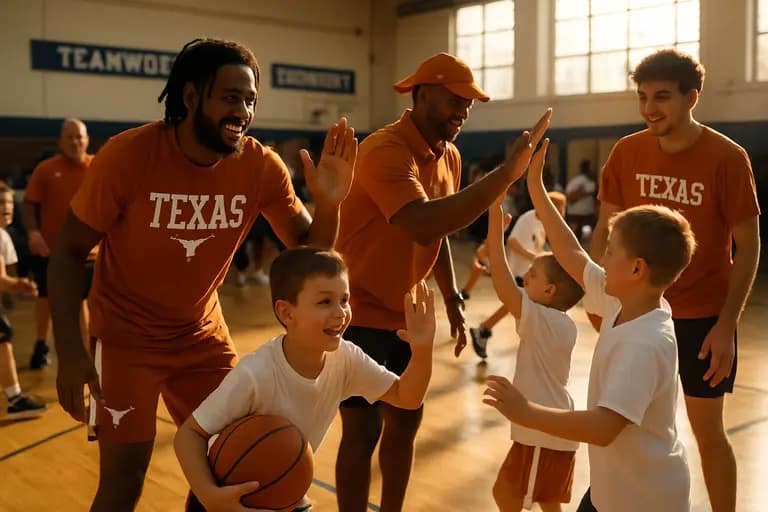
What Fans In Austin And College Station Could Feel
The research notes describe renewed community interest, stronger school spirit, and more attention around the rivalry. Those points fit the nature of this matchup, but the supplied material does not provide attendance totals, hotel figures, sales-tax data or local business revenue. Because of that, the community impact is best discussed with care rather than treated as a measured economic total.
What can be said with confidence is that the rivalry connected two large university communities through repeated athletic events during the 2025–26 academic year. Students had more reasons to follow sports outside their usual favorites. Alumni had a yearlong scoreboard to discuss. Local fans in Austin and College Station had another layer of pride attached to games and meets that might otherwise draw less statewide conversation.
The November 28, 2025 football game in Austin received major media attention in the research, and that is not surprising given the long break before the rivalry resumed and the stakes attached to Texas A&M’s SEC title hopes. Football may have brought the loudest statewide spotlight, but the final trophy showed why volleyball, tennis, track and field, and basketball mattered to the same fan communities.
Why Local Sports Economies Need Real Numbers
The research summary says the series boosted local economies in College Station and Austin through tourism and business activity during game weekends. That claim is reasonable as a topic for local discussion, but the supplied notes do not include public data showing the size of that effect. Without verified totals, it would be unfair to attach a dollar figure or compare the two cities.
Still, the sports mechanism is clear. Rivalry games bring visiting fans, alumni gatherings, campus events and restaurant traffic. In college towns, those weekends can matter to small businesses near campus and along travel routes. The safest takeaway is not a number; it is that a renewed rivalry creates more reasons for people to gather, travel and spend time around local sports spaces.
Why The Lone Star Showdown Still Matters In Texas
The Rivalry Stayed Bigger Than One Scoreboard
The Lone Star Showdown gave Texas A&M more than bragging rights for one night. It gave the Aggies a yearlong department achievement built across several sports, including a volleyball national championship, women’s tennis consistency, track and field success, and a men’s basketball split that kept the hardwood rivalry balanced.
For Texas, the 27–17 football win in Austin remained a major rivalry result. It also showed why this series can be so compelling for local fans: one school can own the loudest single moment while the other wins the trophy. That tension keeps debate alive without needing exaggeration.
For basketball communities across the state, the lesson is familiar. Rivalries are built through repeated meetings, shared memory and local identity. The 2025–26 result did not erase Texas basketball pride, and it did not reduce the importance of the Longhorns’ football win. It did give Texas A&M a clear all-sports achievement to celebrate and a stronger argument that its athletic department answered the renewed rivalry across the full calendar.
The next chapter will be judged by new games, new rosters and new campus energy, but the 2025–26 trophy already has its place: Texas A&M won the resumed series, and the result reminded both sides that in Texas college sports, the rivalry rarely belongs to only one team or one night.