

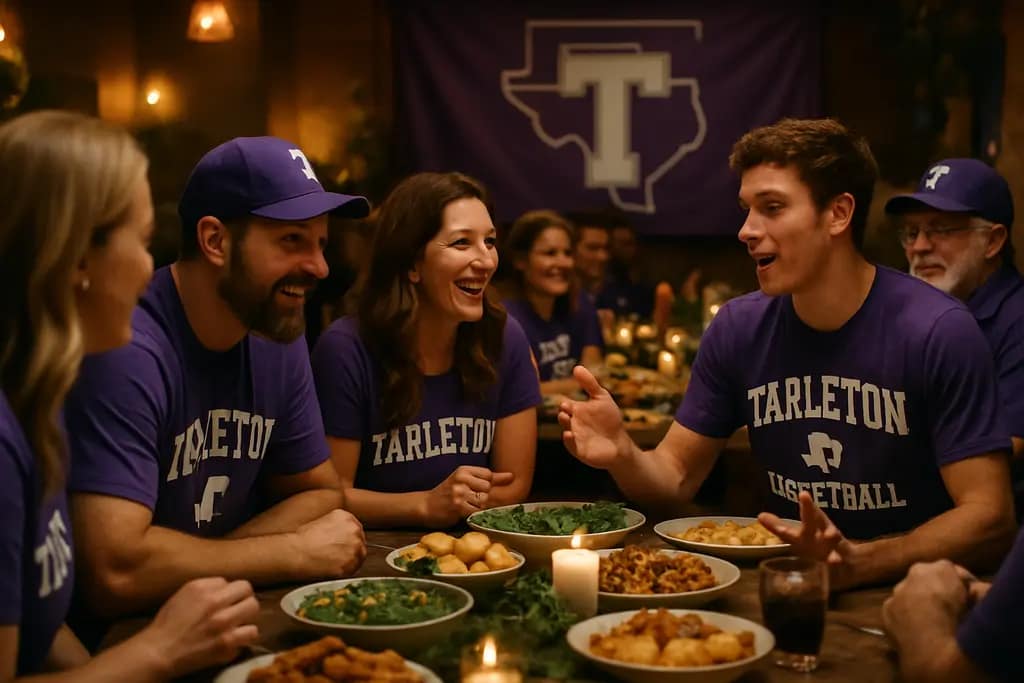
The Tarleton Fall Luncheon on October 13, 2026 gives Stephenville basketball fans their first public checkpoint before Eric Haut’s debut season as Tarleton State men’s basketball head coach. The event is scheduled for noon to 1 p.m. at City Hall at City Limits, is open to the public with a $10 ticket, and includes President Dr. James Hurley, men’s basketball coach Eric Haut, women’s basketball coach Bill Brock and cross country coach Bobby Carter, with an RSVP deadline of October 9, according to Tarleton athletics.
For men’s basketball, the timing matters. Haut was named head coach on March 12, 2026 after working at Utah State as associate head coach, and his first roster in Stephenville has been built through a heavy transfer cycle. That gives the luncheon more weight than a standard preseason meet-and-greet. It is a chance for local supporters to hear how the staff is connecting a new roster, defining roles and preparing for a schedule that will test the Texans well before conference play begins.
Why Tarleton Fall Luncheon Matters Before Tipoff
A Public Room For Program Direction
The Tarleton Fall Luncheon should not be treated as a full scouting report. Coaches rarely lay out rotation plans or tactical wrinkles in a public setting before games begin. Its value is different. Fans can learn the language Haut uses around his team, the traits he emphasizes, and the way he frames the first months of a new staff.
That matters at Tarleton because men’s basketball is entering a reset on several fronts. The Texans are moving forward after a 14-18 record in 2025-26 and a 5-13 mark in Western Athletic Conference play. The numbers from that season show a team that was close enough offensively to stay competitive many nights, averaging 74.5 points per game while allowing 73.4, but still had areas that limited consistency. Tarleton shot .450 from the field, .322 from three-point range and about .745 at the free throw line, while finishing with a minus-1.6 rebounding margin per game.
Those figures create the basketball questions that can sit beneath the luncheon conversation. Can the new staff improve shot quality? Can a transfer-heavy roster rebound well enough to support its pace? Will older guards and wings settle the offense early, or will the Texans need weeks of game reps to find clean spacing?
Tarleton Fall Luncheon Questions For Fans
The Tarleton Fall Luncheon can help fans listen for answers without expecting the coach to reveal every plan. The best questions are about identity, not secrets. Haut’s background includes stops at Utah State, Northern Kentucky and Kent State, so his first public preseason comments in Stephenville can show how he wants to translate that experience into a Tarleton program with a new league path and a remade roster.
Community events also matter in a college town because they shorten the distance between the program and the people who fill the gym, support booster activity and follow recruiting news. A lunch setting allows fans, alumni and local business supporters to hear from several Tarleton leaders in one room. For a new men’s basketball staff, that local buy-in is not cosmetic. It can shape early patience, crowd energy and the sense that the team belongs to Stephenville before the first tough road trip arrives.
Roster Construction Puts Coaches In The Spotlight
Transfers Change The Early Evaluation
Tarleton’s 2026-27 roster has 16 players: four returners, 11 portal additions and one incoming freshman. Twelve of the 16 are juniors or seniors. That kind of roster composition changes the normal development clock. This is not a group built mainly around long-term freshmen who can learn through gradual minutes. It is an older team assembled to compete quickly while still learning a new staff’s standards.
The transfers give Haut and his staff flexibility, but they also create a demanding coaching task. Portal players arrive with habits from previous programs. Some have been primary options. Others have been role players asked to defend, rebound or space the floor. The staff has to sort out who can handle the ball, who can play through contact, who talks defensively and who can accept fewer shots without losing impact.
Trey Harris, a West Virginia State transfer guard added in June 2026, brings reported perimeter shooting, dribble creation and size. Josh Hayes, a transfer from Utah, completed the signing cycle later as the final player in the class and was described as adding size and basketball IQ. Those two additions point toward a clear priority: Tarleton wanted more experienced skill and physical tools, not only depth.
Staff Chemistry Matters As Much As Player Fit
Haut’s staff has also taken shape with Brandon Ubel, Jean Prioleau, Jake Williams, Tre Cobbs and Bo Gray. Ubel was the final addition and brings overseas professional playing experience along with recruiting work inside Texas. In a first-year build, assistant coaches are more than bench voices. They are the daily connectors between scouting, player development, recruiting relationships and individual accountability.
For a roster with 11 transfers, staff organization can show up quickly. Position coaches must teach terminology fast. Recruiters have to keep future classes moving while the current team is still settling in. Player development work has to identify which skills can realistically improve between October practices and the early conference window. The staff also has to evaluate returners carefully because continuity carries value when so much else is new.
That is where the coaches and recruiting angle becomes especially important for local followers. The first year under Haut is not only about wins and losses. It is also about whether Tarleton can create a repeatable roster model in the portal period while still maintaining ties to Texas prospects, junior college routes and long-term player growth. The state’s basketball calendar is full of evaluation opportunities, from school-team fall leagues to camps and showcase settings, and Tarleton’s staff will need a clear presence in that broader player-development conversation. For families tracking exposure events across the state, the Texas fall camp circuit shows how recruiting access remains spread across regions.
Schedule Pressure Will Reveal The Rotation
A Larger Non-Conference Slate Tests Depth
Tarleton has a Division I record 16 regular non-conference games scheduled for 2026-27, plus two exhibitions. That creates a demanding runway for a new staff. Non-conference play is often where coaches experiment with lineups, test defensive pairings and learn which combinations survive on the road. With an older roster, the Texans may be able to handle travel and scouting adjustments better than a younger group, but chemistry cannot be assumed.
The schedule includes road games against USC on November 19, 2026 and Pittsburgh on December 5, 2026, giving Tarleton two Power Four opponents away from Stephenville. The road trips extend across five states outside Texas. Those games will not define the full season by themselves, but they will expose weaknesses quickly. Ball security, defensive rebounding and half-court execution often become harder against bigger, longer opponents.
For fans attending the Tarleton Fall Luncheon, schedule talk should be heard through that practical lens. The goal is not just to circle the biggest-name opponents. The better question is how the staff plans to use a long non-conference stretch to find trustworthy groups before United Athletic Conference play begins.
Conference Change Adds Another Layer
Tarleton joined the United Athletic Conference on July 1, 2026, and the men’s basketball UAC schedule begins on January 6, 2027 with a home game against Central Arkansas. That date gives the staff a defined deadline. By then, the Texans should know their primary ball handlers, closing lineup options, defensive identity and frontcourt rotation.
The conference move also affects recruiting language. Coaches can sell a new league chapter, a chance to play early, and the opportunity to help define Tarleton’s first men’s basketball push inside its new conference setting. For transfers, that pitch may be direct: come to Stephenville, earn a role and help establish standards under a new head coach. For high school players, the message may be more developmental: the staff is building a program that will need continuity after this older roster moves through.
What Stephenville Should Listen For At Tarleton Fall Luncheon
Identity Clues Over Rotation Promises
The most useful takeaways from the Tarleton Fall Luncheon will likely come from tone and priorities. If Haut stresses defensive rebounding, that connects directly to last season’s minus-1.6 rebounding margin. If he talks about pace, shot selection or free throw pressure, that links to a team that scored enough to stay close but still finished below .500. If he highlights maturity, that fits a roster with 12 juniors or seniors.
Fans should also listen for how he discusses returners. Transfer additions attract attention because they are new, but returning players often understand campus expectations, travel habits and the emotional demands of a season. A healthy mix of new talent and returning voices can help an older roster avoid becoming a collection of short-term pieces.
For Stephenville, the event is also a reminder that college basketball programs are built in public and private at the same time. Practices, film sessions and recruiting calls happen away from the crowd. Luncheons, home games and community appearances bring the program back into town life. Tarleton’s men’s basketball season will be judged on the court, but early community trust can help frame the first months of a new era with fair expectations and stronger local support.
A Local Checkpoint For A New Era
The Tarleton Fall Luncheon arrives before the first official games, but it already sits at the intersection of coaching, recruiting and fan engagement. Haut has a completed staff, a transfer-driven roster and a schedule built to test the Texans before UAC play. The luncheon gives supporters a chance to hear how those pieces are being presented before results start shaping the conversation.
That makes October 13 more than a calendar item for the Texan Club. It is an early public reading of where Tarleton men’s basketball wants to go, how quickly the new staff believes this roster can connect, and what Stephenville can expect as the program opens a new chapter under Haut.