

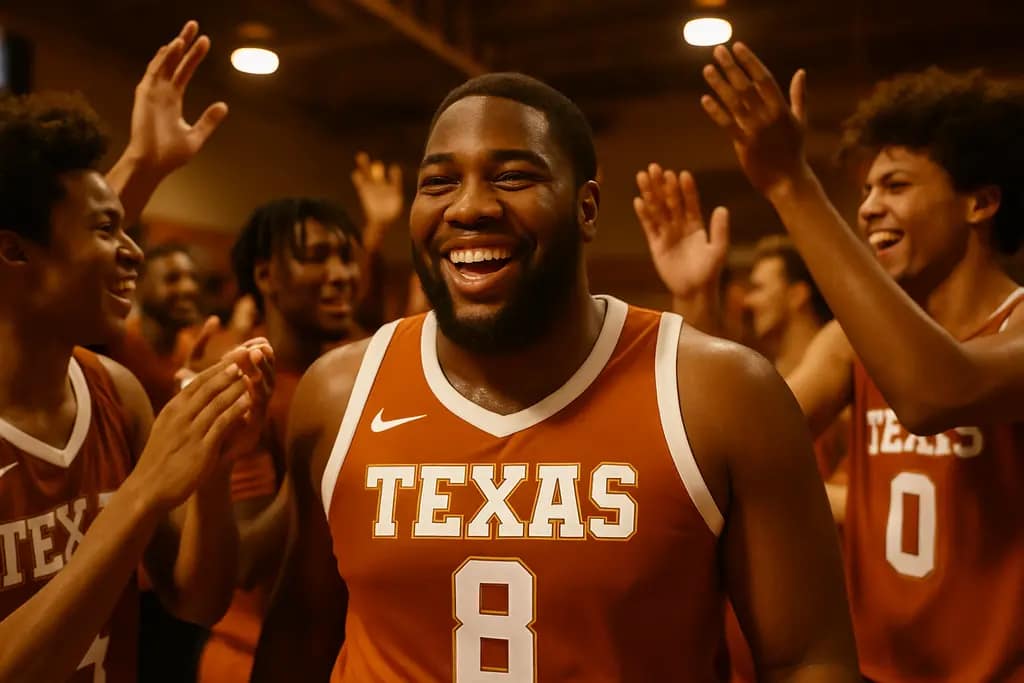
Marcus Spears Commitment became official on July 10, 2026, when Texas announced that Marcus Spears Jr. had signed an Athletic Scholarship Agreement to join the Longhorns for the 2026-27 season after reclassifying from the Class of 2027. For a Texas program trying to build a deeper frontcourt and keep elite local talent close to home, the signing carried meaning beyond one roster spot.
Spears is a Frisco, Texas forward from Dynamic Prep, listed by Texas at 6-foot-10 and 210 pounds. His arrival gave the Longhorns a high-end local prospect with national production, USA Basketball experience and a development runway that matters for roster planning. Texas also said its 2026 recruiting class moved to No. 1 nationally in the 247Sports ranking at the time of his signing, a jump tied heavily to Spears joining the group Texas announcement.
That does not mean Texas should treat Spears as a finished college star from the first week. The more useful view is that the Longhorns added a rare frontcourt piece who can grow into a larger role while giving the staff more lineup flexibility. For local fans, the signing also reinforces a bigger recruiting point: North Texas continues to produce players capable of changing the direction of major college programs.
What The Marcus Spears Commitment Changed
Why Marcus Spears Commitment Moved The Class
The first measurable effect came in recruiting perception. Texas reported that Spears was ranked No. 4 nationally by ESPN, No. 7 by Rivals Industry and No. 8 by 247Sports in the 2026 class after reclassification. Those rankings explain why one signing had such a clear effect on the Longhorns’ national class standing.
Texas has signed elite prospects before, but this one stands out because of fit. Spears is not a scoring guard added to an already crowded perimeter. He is a 6-foot-10 forward with rebounding, shot-blocking and scoring production against strong competition. The body type alone matters in high-major basketball, where frontcourt depth is often tested by foul trouble, injuries, matchup demands and physical conference play.
The Marcus Spears Commitment also gave Texas a recruit with proven production in multiple settings. At Dynamic Prep, he averaged 15.1 points, 7.6 rebounds and 2.4 blocks per game as a junior while helping the team finish 39-5 and reach the Chipotle Nationals semifinals. On the Spring 2026 Nike EYBL circuit, he averaged 20.9 points and 8.7 rebounds per game. Texas noted he was the only player to rank in the top ten nationally in both scoring and rebounding on that circuit.
The Reclassification Piece Matters
Reclassification is not just a calendar note. It changes the speed of development. Spears moved from the Class of 2027 into the 2026 class, which meant Texas gained access to him a year earlier than the original recruiting cycle suggested. That gives the Longhorns an earlier chance to build his college habits: defensive positioning, strength work, practice pace, communication and offensive reads against older players.
For fans, the key is patience. Reclassifying does not erase the adjustment from high school and grassroots basketball to college. Spears’ ranking and production make him one of the most important young players on the roster, but the best version of his Texas career may come as his body and role mature over time.
The Skill Profile Texas Added
Scoring And Rebounding Travel Well
Spears’ statistical profile is encouraging because it is not built around one isolated skill. He scored, rebounded and blocked shots at Dynamic Prep. He then increased his scoring output in Nike EYBL play while still ranking near the top nationally as a rebounder. That blend matters because college coaches can keep useful frontcourt players on the floor even when their offensive usage changes.
If Spears is not asked to be the first option immediately, he can still affect games through rebounding, rim protection and activity around the paint. That is where high-level forwards often earn early minutes. A player who can finish plays, contest shots and prevent second chances gives a team value without needing the offense to run through him.
His FIBA experience adds another layer. At the 2025 FIBA U16 Men’s AmeriCup, held June 2-8, 2025, in Juárez, Mexico, Spears started all six games. Texas reported that he averaged 14.0 points, 6.5 rebounds, 2.0 steals and 1.8 blocks per game and was selected to the All-Star Five. International youth competition does not guarantee college impact, but it does expose players to different spacing, officiating and styles of play.
Why Defense Could Define His Early Role
On3’s evaluation framed Spears as an addition who could strengthen Texas at the power forward and small-ball center spots, especially alongside returning players such as David Punch On3 scouting report. That is the most practical short-term lens for his future.
The Longhorns do not need to reduce his value to points per game. If Spears can defend without fouling, rebound in traffic and give Texas credible interior length, his minutes can grow naturally. The college game will test his strength and decision-making, but his high school, EYBL and FIBA production all point to a player who can impact more than one column.
The Marcus Spears Commitment gives Texas a chance to build lineups with more size while still keeping frontcourt mobility in play. That matters against opponents that use smaller, quicker groups as much as it matters against traditional post-heavy teams. A forward with small-ball center potential gives a staff more ways to answer matchup stress.
Roster Meaning For The Texas Frontcourt
Depth Reduces Pressure On One Player
The best part of this signing may be that Texas does not have to rush Spears into being the entire frontcourt answer. On3 projected that his impact could grow over two seasons rather than making him the immediate primary star. That is a healthier setup for a young big who reclassified.
Frontcourt development often depends on details that do not show up in recruiting rankings. Young forwards have to learn screening angles, help-side timing, post defense without reaching, and when to pass out of traffic. They also have to adjust to stronger college bodies. Spears has the physical tools and production to push for a role, but depth gives Texas room to teach while still competing.
That is why his fit next to returning frontcourt pieces matters. If Texas can pair him with players who absorb difficult defensive assignments or handle more physical matchups, Spears can be used in roles that match his growth curve. If he develops faster, the roster gains a higher ceiling. If the adjustment takes time, the Longhorns still have a long-term asset rather than a one-week headline.
How His Role Could Grow
A reasonable early path starts with defense, rebounding and finishing. From there, Texas can expand his responsibilities based on how quickly he handles college speed. His EYBL scoring average shows offensive upside, but usage at Texas will depend on spacing, ball movement and the strengths of the rest of the roster.
For a fan base that studies recruiting closely, the lesson is to separate ranking from role. A top-ten national prospect can still need time. The value is not only in what Spears gives Texas on his first night in uniform. It is in how much more complete the frontcourt could become as his minutes, strength and responsibilities increase.
For more local context on how his signing fits the program’s planning, our earlier analysis of his Texas recruiting fit focused on why a two-season frontcourt piece carries extra weight in Austin.
Why Frisco And Dynamic Prep Matter To Texas Fans

A Local Win With Statewide Meaning
The local angle should not be treated as a side story. Spears comes from Frisco and played at Dynamic Prep, giving Texas another direct connection to a strong North Texas basketball pipeline. For families and high school coaches across the state, that matters. When an elite Texas prospect signs with the Longhorns, it strengthens the idea that Austin can be a destination for players who do not need to leave the state to find national competition.
Texas basketball identity has often been shaped by how well the program recruits its own state. The Marcus Spears Commitment gives the Longhorns a visible example to point toward in gyms across Dallas-Fort Worth, Houston, San Antonio, Austin and smaller communities. It says the program can compete nationally while still building from the state’s best players.
That matters to local fans because recruiting is not abstract in Texas. Supporters often remember where a player starred in high school, which grassroots circuits he played, and how often they heard his name before he reached college. Spears arrives with that kind of local familiarity, which can deepen fan investment before he plays major minutes.
Community Interest Follows Familiar Players
Spears’ path also gives younger players a reference point. A Frisco forward developed through Dynamic Prep, produced on the EYBL circuit, represented the United States at a FIBA youth event and signed with Texas after reclassifying. That path is not easy to copy, but it is visible. Visibility helps young athletes understand the level of work and competition required.
For Texas fans, the signing offers a reason to track more than box scores. Player development will be part of the story. How Spears handles physical play, how his defensive discipline improves, and how Texas uses him in different frontcourt combinations will tell us more than his recruiting ranking alone.
What The Marcus Spears Commitment Means For Texas Basketball
The Marcus Spears Commitment gave Texas a major recruiting lift, but its real value will be measured through development. The Longhorns added size, national credibility and a frontcourt player whose production has already traveled from Dynamic Prep to EYBL play to international youth competition.
The smart expectation is not instant stardom. It is steady growth inside a deeper roster. Spears has the profile to help defensively, rebound, finish around the basket and eventually take on more offensive responsibility. Texas has the chance to bring him along without treating one freshman as the entire answer.
For the local basketball community, this signing also carries pride. A Frisco player staying in state to join the Longhorns connects high school gyms, grassroots events and the college game in a way fans can follow closely. If Texas turns that connection into real development, Spears could become more than a recruiting win. He could become one of the frontcourt pieces that helps define the program’s next phase.