

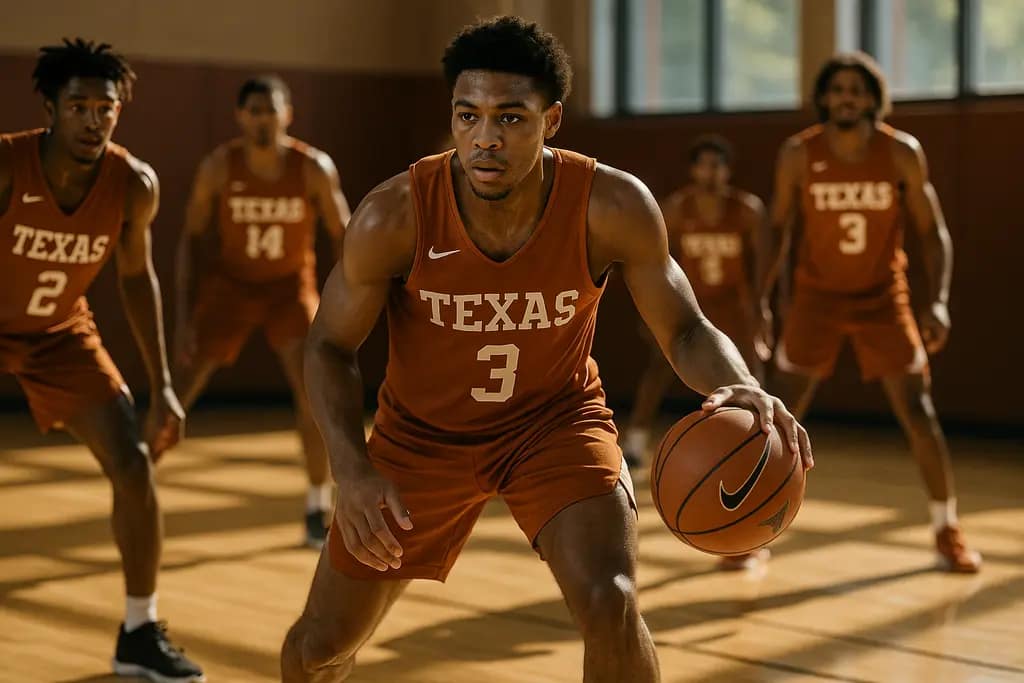
The Amari Evans transfer gives Texas a guard who already has SEC minutes, a defensive reputation and three years of collegiate eligibility remaining. Evans, a 6-foot-5, 220-pound guard, moved from Tennessee to Texas in April 2026, and the Longhorns announced his signing as part of Sean Miller’s program build Texas announcement.
For Texas fans, the appeal is not just that Evans is young or physically ready for high-major basketball. It is that his first college season offered a clear identity. He played through contact, rebounded from the guard spot and generated steals in a league Texas knows well. That gives Miller a player whose role can begin on the defensive end while the offensive package keeps growing.
What The Amari Evans Transfer Adds To Texas
Why The Amari Evans Transfer Fits A Development Window
Evans arrives with time. Texas lists him with three years of collegiate eligibility remaining, which gives the staff a longer runway than a one-year portal addition. That matters for player development because guards with size often need reps across several areas: ball pressure, defensive communication, transition reads, spot-up shooting and late-clock decision-making.
The Amari Evans transfer also fits the current need for roster depth. Yahoo Sports reported that Evans joined other transfer additions, including former Colorado guard Isaiah Johnson and former TCU forward David Punch, as Sean Miller continued to rebuild the Texas roster Yahoo Sports report. That does not guarantee a starting role or a fixed rotation spot. It does give Texas another perimeter option with a college season already on his résumé.
Size And Defensive Habits Stand Out First
Evans’ profile starts with his frame. At 6-foot-5 and 220 pounds, he has enough size to defend guards and wings depending on the matchup. Texas does not need to sell that as projection alone. His Overtime Elite record and Tennessee freshman numbers show a player who has built much of his value around activity.
During his final two high school seasons, Evans attended Overtime Elite in Atlanta. As a senior, he averaged 15.8 points, 7.3 rebounds, 3.8 assists and 2.5 steals per game while earning First Team All-Overtime Elite honors. Texas also credited him as a two-time Overtime Elite Defensive Player of the Year and the league’s career steals leader with 118.
Why His Tennessee Minutes Matter
SEC Film Offers A Cleaner Projection
The cleanest part of Evans’ evaluation is that Texas does not have to guess how he responds to SEC play. As a freshman at Tennessee in 2025-26, he appeared in 35 games, started two and averaged 4.1 points and 3.2 rebounds in 14.4 minutes per game. He tied for third on the team with 34 steals, according to Texas’ signing release.
Those numbers are not superstar numbers, and they should not be treated that way. They are useful because they came in real minutes for a program competing in the same conference Texas calls home. For a staff shaping a rotation, that is different from adding a player who has only high school tape or limited college exposure.
Evans’ SEC-only production also gives Texas something to study. In conference play, he raised his averages to 5.2 points, 3.5 rebounds and 1.4 steals in 18.1 minutes per game. That shows his role did not disappear as the schedule became more familiar and more physical. It also suggests his defensive activity could travel with him to Austin.
The Vanderbilt Game Shows The Offensive Ceiling
One game should never define a transfer evaluation. Still, Evans’ season-high performance against Vanderbilt gives Texas fans a picture of what a bigger offensive night can look like. On March 7, 2026, he scored 24 points on 9-of-18 shooting and added six rebounds and three steals.
That stat line matters because it included more than scoring volume. The rebounds and steals were still present, which is a useful sign for a young guard. If Evans can keep his defensive floor steady while adding more efficient scoring nights, Texas gains a player who can help without needing the offense to run through him every possession.
Development Points For A Physical Guard
Defense Is The Starting Point
The Amari Evans transfer should be judged first by what he can do defensively. Yahoo Sports described him as a player expected to bolster Texas’ perimeter defense and provide backcourt versatility. That role makes sense based on his steals at Overtime Elite, his Tennessee production and his physical profile.
For Miller’s staff, the next step is turning activity into dependable possession-by-possession defense. Steals are valuable, but college coaches also need guards who can stay attached without fouling, rebound down from the perimeter and handle screening actions. Evans has the tools to earn trust there, and Texas has time to develop the details.
- Use his size to guard multiple perimeter spots when matchups allow.
- Keep rebounding as part of his guard identity.
- Turn defensive events into transition chances without forcing plays.
- Grow as a half-court offensive option beside other ballhandlers.
Offense Remains The Next Step
Evans’ offensive growth will likely decide how large his role becomes. The research supports a player who has produced in bursts, including the Vanderbilt game, and who had strong high school numbers at Overtime Elite. The question is how consistently that scoring translates within Texas’ spacing, shot selection and guard rotation.
That development does not have to happen all at once. A realistic early path could begin with transition finishes, cuts, offensive rebounds, straight-line drives and open shots created by teammates. If his handle, passing reads and shooting consistency improve over time, his role can widen.
How Texas Fans Can Read The Roster Fit

Not Every Transfer Has To Be A Headliner
The portal often pushes attention toward immediate scoring totals. Evans is a different type of addition. His value may show up in defensive possessions, lineup flexibility and the ability to survive physical SEC stretches. That can be harder to measure from a box score, but it matters inside a long season.
Texas fans should also keep the roster context in mind. Evans joins a program being rebuilt under Miller, not a finished rotation with every role settled. That creates opportunity, but it also creates competition. His Tennessee experience gives him a base; his development in Austin will decide how much of that base becomes consistent production.
For readers tracking this move in more detail, our related piece on how the Amari Evans transfer fits Texas basketball looks at his defensive profile and roster timing from another angle.
Local Fan Interest Starts With Identity
Texas basketball fans have seen many portal additions come through Austin in recent years. The ones who connect fastest are often the players whose roles are easy to understand. Evans has that advantage. A physical guard who defends, rebounds and pressures the ball gives the Moody Center crowd something to recognize even before the scoring fully arrives.
That matters for community connection, too. Young guards across Texas can see a development path that is not built only around high-volume scoring. Evans’ track record shows that defense can move a player from Overtime Elite to Tennessee and then to Texas. For high school players watching the Longhorns, that is a practical lesson.
Why Evans’ Growth Matters In Austin
For Texas fans, the Amari Evans transfer is best viewed as a development bet with a clear starting point. Evans already has size, SEC experience and a defensive résumé. He does not need to arrive as a finished offensive player for the move to make sense.
The key will be how Texas shapes his role. If he earns minutes through defense and rebounding, the staff can let the offense grow within a defined job. If he turns his flashes of scoring into steadier production, the Longhorns could have a multi-year guard who gives the roster more balance.
That is why this addition should interest more than recruiting watchers. It touches the daily work of building a college player: practice habits, role acceptance, defensive consistency and gradual offensive expansion. Evans gives Texas a player with enough early evidence to believe the foundation is real, while still leaving room for meaningful growth in Austin.